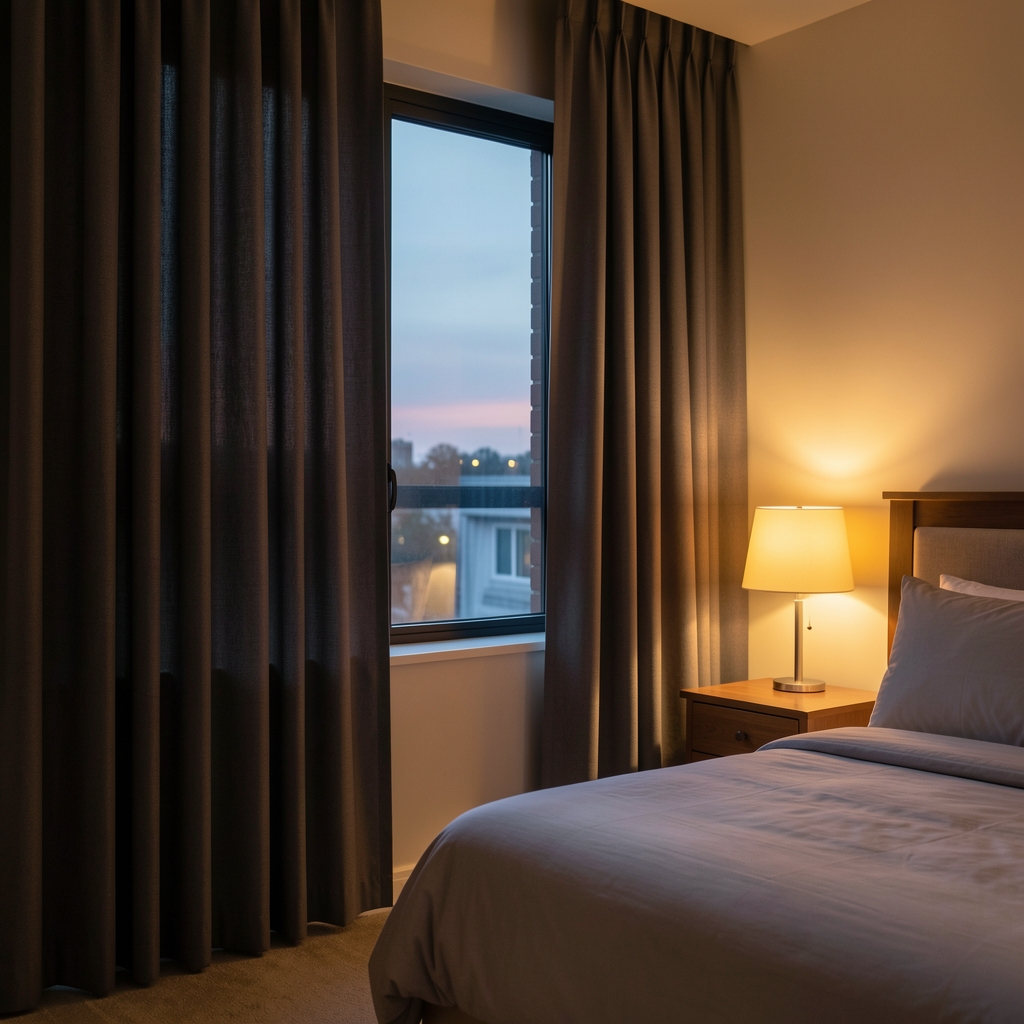
A room's environment carries more weight in the sleep equation than many accounts suggest. The popular emphasis on routines and habits — what one does in the hour before bed — tends to overshadow a prior question: what kind of space does one sleep in? The material conditions of a bedroom are not incidental. They represent the physical context within which the body's own preparation for rest either proceeds freely or meets resistance.
Two variables — light and temperature — receive the greatest attention in published research on bedroom environment, and their significance is not independent of one another. Both operate on the same underlying system: the circadian rhythm, the body's internal timing architecture that governs the transition between wakefulness and sleep across the twenty-four-hour cycle.
Key Observations
- Even low levels of light during sleep can fragment rest cycles and reduce slow-wave depth
- A bedroom temperature between 16°C and 19°C corresponds with the body's preferred sleep-onset range
- Blackout curtains produce measurably different rest outcomes compared to light-permeable alternatives
- Ambient sound at a steady, low level (such as white noise) can reduce the disruption caused by intermittent noise
- The combination of darkness and reduced temperature is more effective than either variable in isolation
The Question of Darkness
The case for a dark bedroom begins with the circadian system's sensitivity to light. The retina contains photoreceptor cells — intrinsically photosensitive retinal ganglion cells — that detect light levels independently of the visual pathway and communicate directly with the suprachiasmatic nucleus, the brain's principal circadian regulator. These cells respond to light across the night, including light levels that are well below those typically associated with wakefulness.
The practical implication is that a bedroom that admits moderate levels of ambient light — from street lamps, from digital clocks, from standby indicators on devices — may be maintaining a degree of circadian arousal that reduces the depth of slow-wave sleep. Slow-wave sleep, the deepest stage of the sleep cycle, is the period during which the body's recovery processes are most concentrated. Reducing its depth or duration has measurable effects on the felt quality of rest the following day.
"Darkness is not merely the absence of light. It is a condition that the body's circadian system actively reads — and reads with more precision than we tend to assume in our choices of bedroom furnishing."
The practical measure most consistently associated with improved sleep depth in published observational accounts is the use of blackout curtains or blinds. The name is somewhat more absolute than the product typically warrants — complete darkness is achievable in a purpose-fitted room, but most bedroom environments aim for a level of darkness that eliminates ambient intrusion from the street or neighbouring buildings. In London and other urban contexts, where ambient light levels through the night are substantial, this represents a meaningful intervention in the sleep environment.
Temperature: The Body's Own Clock
Core body temperature follows a reliable circadian rhythm. It peaks in the late afternoon and early evening, then declines progressively through the night, reaching its lowest point in the two to three hours before the habitual waking time. This decline is not a passive consequence of reduced metabolic activity during sleep; it is an active regulatory process that the body initiates as part of its preparation for rest.
A bedroom temperature that is warmer than the body's preferred sleep-onset range creates a situation in which the body must work harder to achieve the core temperature reduction that initiates the sleep state. Published research has returned repeatedly to a relatively narrow band — broadly between 16°C and 19°C for most adults in temperate climates — as the range within which sleep onset and depth are most reliably supported.
The exact figure varies between individuals, and it varies with age, with fitness, and with the level of physical activity during the preceding day. What is consistent across the available literature is the directional observation: a cooler room supports the body's own temperature regulation rather than working against it.
The Relationship Between Light and Temperature
The interaction between these two variables is worth noting. A dark room and a cool room both act on the circadian system, but they act through somewhat different pathways. Light acts primarily through the retinal-hypothalamic axis; temperature acts through peripheral thermoreceptors and through the balance between heat loss at the body's surface and core temperature. Both pathways converge on the same output: the initiation and maintenance of the sleep state.
What this means in practice is that optimising one variable while neglecting the other produces a partial result. A very dark room at an uncomfortably warm temperature will reduce one source of circadian disruption while leaving another in place. A cool room with moderate ambient light will do the reverse. The combination of darkness and appropriate temperature reduction appears to be substantially more effective than either variable applied independently, because both simultaneously support the same physiological transition.
Ambient Sound and the Sleep Environment
Beyond light and temperature, ambient sound represents a third variable that is harder to control but significant in its effects. Intermittent noise — the kind produced by traffic, by neighbours, by central heating systems cycling on and off — produces arousal responses in the sleeping brain that may not rise to the level of full waking but that nonetheless fragment the architecture of the sleep cycle.
Published research on noise and sleep has explored a range of mitigation approaches. The most consistent finding is that steady, low-level ambient sound — sometimes described as "white noise" or "pink noise", depending on the spectral distribution — can reduce the perceptual salience of intermittent disturbances by raising the baseline sound level against which spikes are measured. The mechanism is masking rather than elimination: the disturbing sound is still present, but the contrast between it and the background is reduced.
This does not suit every sleeper, and the literature is careful not to advocate for a single approach. What emerges from the available evidence is the more modest observation that the acoustic environment of a bedroom deserves the same deliberate attention as its visual and thermal environment.
A Note on Material Choices
The sleep environment extends beyond curtains and thermostats. Pillow choice, mattress material, and the thermal properties of bedding all bear on the body's temperature regulation during sleep. Natural fibres — wool and cotton in particular — have better moisture-wicking properties than synthetic alternatives and support the body's perspiration-based temperature regulation more effectively. This is a consideration that the marketing of bedding products has sometimes overstated, but the underlying observation — that breathable bedding supports temperature regulation — is well-grounded.
The practical conclusion from the available evidence is not prescriptive. Different bodies in different climates and different seasons will require different calibrations. What the research does establish is a framework: a dark room, a cool room, a quiet room, and bedding that supports rather than impedes the body's own thermal management. These are the conditions in which rest becomes consistently possible.